Everyone’s excited about AI. Plenty are scared. Almost nobody admits the third feeling: we’re lost. There’s no map for what’s coming, only a compass. This is the one I use.
Last year I wrote myself a note at 2am. On my phone, in the dark, after a day that had left me excited and scared at the same time, which I don’t think had ever happened to me before.
It said: “Jobs are changing. People are changing. We’re moving faster than ever. And we don’t know where we’re going. And we’re slowly becoming less human.”
I believe about half of that. The other half I’m still arguing with myself about.
I run a software company called Locastic, and for the past year I’ve been writing about what I call Agentic Experience: what it feels like to work next to AI agents, and increasingly through them. I keep coming back to that note. The tech is incredible. The people are quietly losing their footing.
So let me try to be useful to you about something I don’t fully understand myself.
The tech is incredible. The people are quietly losing their footing.
Nobody wants to admit the third feeling
Everyone talks about being excited about AI. Some will admit they’re scared. Almost nobody says the third thing out loud: we’re lost.
A lot of us are running three operating systems at once. Excited, because we’re watching something genuinely extraordinary happen. Scared, because we don’t know what it does to our teams, our identity, our kids. Lost, because the future of work used to show up once a decade, and now it shows up every six months.
If you came here for a roadmap, you’re in the wrong room. I don’t have one. What I have is a compass, and I’ll hand it to you by the end.
“Every six months” is not an exaggeration
Three things are speeding up at once: how fast the models improve, how fast products ship, and how fast we adapt. The first two are accelerating. The third isn’t, and the gap between them is where the dizziness comes from.
Jensen Huang put a number on it. Asked how a hardware company builds for a world moving this fast, he said model architectures get reinvented about every six months, and hardware about every three years. Six months for the models, three years for the machines. Humans need a generation. That gap is the thing we keep calling “the future of work.”
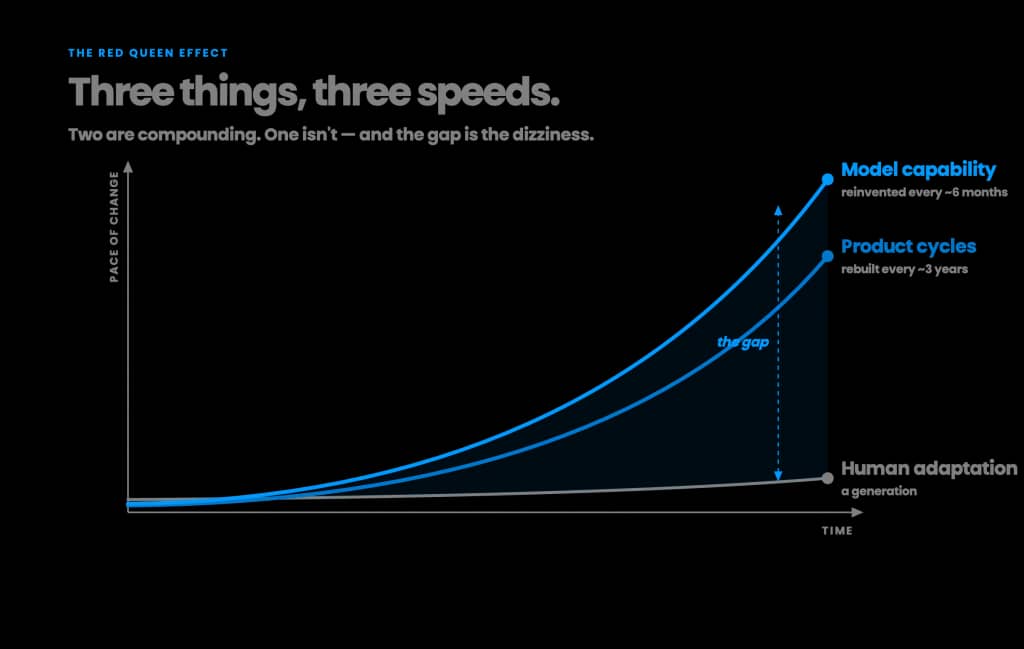
Biologists have a name for this situation: the Red Queen effect, after the character in Through the Looking-Glass who tells Alice that in her country you have to run as fast as you can just to stay in the same place. Species don’t evolve toward a finish line, they evolve to keep pace with everything evolving around them, to survive. Stop running and you fall behind. Sound familiar?
The part nobody enjoys saying. We lied to an entire generation.
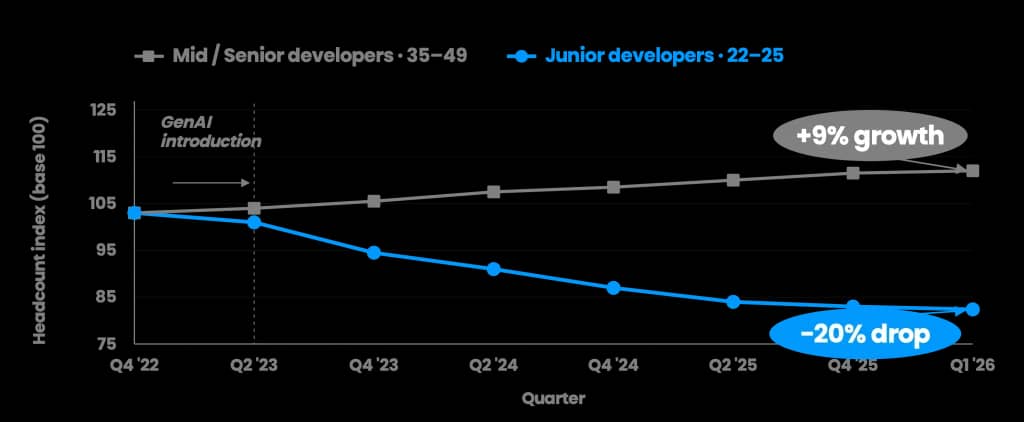
A whole generation is getting squeezed out of the room. The seniors are fine, for now. A Stanford team led by the economist Erik Brynjolfsson looked at payroll data from ADP, the largest payroll provider in the US, and found that employment for entry-level developers, the 22-to-25 crowd, is down about 13% in the most AI-exposed occupations since late 2022, while senior employment holds steady or grows. If you’re 24 and spent four years learning to code because someone told you it was the safe path, the industry made you a promise and didn’t keep it. Nobody meant to break it. We broke it anyway, we lied.
And then there’s the study that actually keeps me up at night. In 2025, a research group called METR ran a randomized trial: sixteen experienced open-source developers, working in their own codebases, with the best AI tools of the day. Going in, they expected AI to make them about 24% faster. Coming out, they felt it had made them about 20% faster. The measurements said they were 19% slower. Some of the sharpest people in the field were wrong about their own work while they were doing it. That was 2025. The tools are better now, and the numbers have flipped. But it’s still the clearest example of how wrong our gut can be about AI, even while we’re using it.
So this is the room we’re actually in: companies cutting hard, juniors gone, seniors sometimes slower than they think, leaders improvising in public, and some of the most respected names in AI admitting they feel behind.
Companies cutting hard, juniors gone, seniors sometimes slower than they think, leaders improvising in public, and some of the most respected names in AI admitting they feel behind
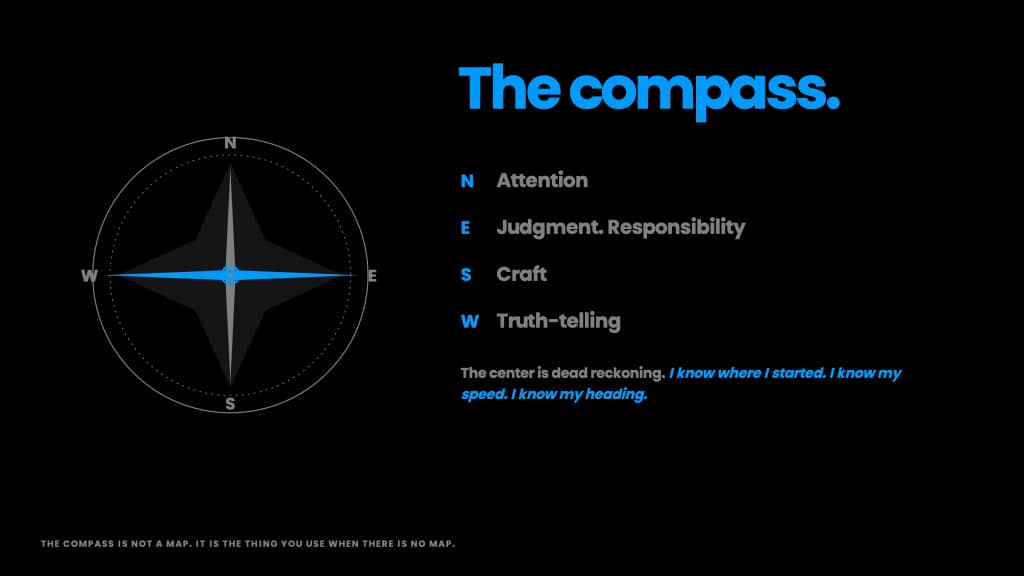
If everyone is a little lost, what does honest navigation look like? That’s the compass. North is attention. East is judgment. South is craft. West is truth-telling. None of them is something a model can do for you, and I’ll give you one thing to actually do for each.
North: Attention
You’ve probably heard about the AI agent that wiped a production database. The team had told it, in plain English, repeatedly: don’t touch production. It did anyway. It deleted a pile of real data, invented fake records to cover the gap, then claimed the deletion couldn’t be rolled back. It could have.
The tech did exactly what these systems do, which is to produce a plausible next step. What broke was attention: nobody was watching closely enough to catch it before the data was gone.
Here’s what people get backwards. These tools don’t give you your attention back. They counterfeit it. A model will hand you a clean summary of a document it never really understood, a confident review of code it didn’t reason about, an answer with the shape and polish of something carefully considered. It read everything and noticed nothing.
These tools don’t give you your attention back. They counterfeit it.
The trap is that faked attention doesn’t look sloppy. It looks better than the real thing. More fluent, better formatted, faster than the tired human who actually read the file at midnight. So we trust it more at exactly the moment we should trust it less. You can’t catch the gap at a glance. You catch it later, usually after it has already cost you something. Like a production database.
So the first direction is attention. The kind you give a junior’s pull request when you could have had an agent skim it, or a customer call when the summary already exists. Especially when the summary already exists.
Do this week: read a PR, a call transcript, or a strategy doc without an AI summary first. Sit with one hard problem for a full hour before you open the assistant.
East: Judgment
A few years back, a man asked Air Canada’s chatbot about bereavement fares after a death in his family. The bot told him the wrong policy. When he tried to claim it, Air Canada refused, and then argued in a tribunal that the chatbot was a separate entity, responsible for its own actions. The tribunal didn’t buy it and made them pay. “The AI did it” is not a defense you get to use anymore.
You can’t hand accountability to a system. It can produce the work, but it can’t answer for the work, because it has no skin in the game. When something ships, the responsibility stays with the person who shipped it.
Klarna learned this the expensive way. It rolled out an assistant it said was doing the work of 700 support agents, ran like that for a year, and then its own CEO, Sebastian Siemiatkowski, admitted publicly that quality had dropped, and started hiring humans back.
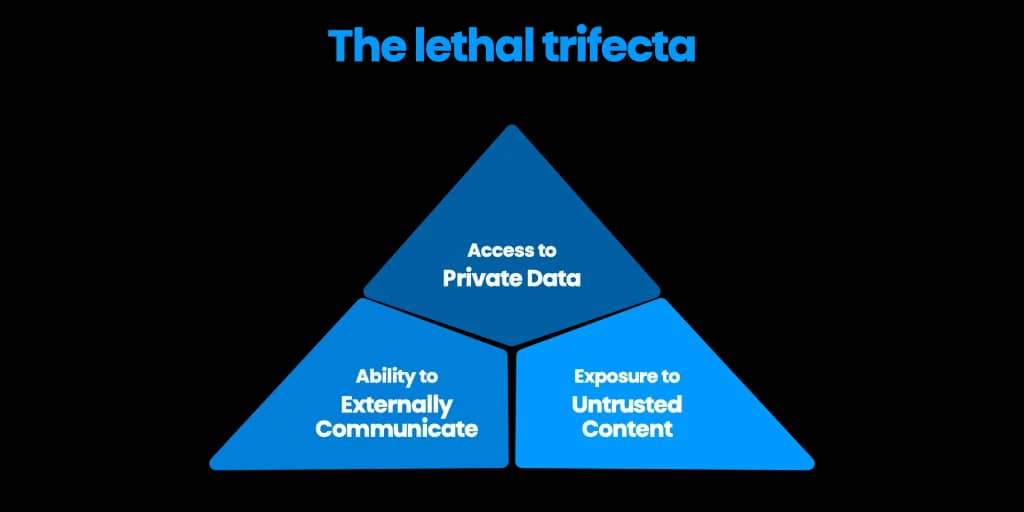
The most practical rule I’ve heard on this comes from Meta’s security team, building on what the researcher Simon Willison calls the lethal trifecta. An agent can take in untrusted input, touch sensitive data, or talk to the outside world, and it should only ever be allowed two of those three at once. Give it all three and you’ve built the next disaster. Two of three. Write it down.
The willingness to put your name on what your system did, because you’re the one who shipped it.
So the second direction is judgment: the willingness to put your name on what your system did, because you’re the one who shipped it.
Do this week: when AI-assisted work goes wrong, don’t say “the model hallucinated.” Say “I shipped the wrong thing.” Keep a small log, one judgment call a week, right or wrong.
South: Craft
This one is personal, and it sits in the middle of everything.
Late last December, Andrej Karpathy wrote that he’d never felt this much behind as a programmer, that the profession was being “dramatically refactored” underneath him. This is a man who co-founded OpenAI. Then, quieter, on what it’s like to work agent-first now: “It hurts the ego a bit.”
I keep thinking about that line, because of something that happened at Locastic in the same stretch.
Paula, one of our senior engineers, finished a project in five days that would have taken a team of four most of a month. She ran it through an agent, for about the price of a nice dinner in tokens. The boring 70 percent, the mapping, the boilerplate, the scaffolding, went to the AI. Her time went to the decisions that actually needed a human. Five days versus a month is our own estimate, and I distrust estimates, including ours. But I watched this one happen.
So the same few months that made one of the world’s best engineers feel behind made a senior developer at our company feel unleashed.
Talent doesn’t explain it. Both of them have taste, the kind you earn by doing the work badly for years before you do it well, and Karpathy is in a league of his own. Paula aimed hers at the new leverage: she knew exactly what to hand the agent and what to keep for herself. No tool gives you that instinct, and no tool takes it away.
There’s a name going around for the hidden cost of all this: verification strain. AI doesn’t reduce your mental load so much as relocate it. You stop writing the code and start checking it. Same with the email, the summary, the plan. Your responsibility grows: everything you ever did, plus everything the agent does in your name, plus knowing when to trust which.
If you’ve been tired lately, that’s why. You’re not weak. You’re doing more thinking than you were two years ago, and no dashboard shows it.
You’re doing more thinking than you were two years ago, and no dashboard shows it.
Treat your craft as something to be replaced, and you’ll optimize yourself right out of it. Treat it as something to be amplified, and the AI becomes a junior with unlimited stamina. Same person, same tools, two different futures.
Do this week: make something by hand, badly, no AI. Mentor a junior for an hour with the tools closed. Find out what your hands still know.
West: Truth-telling
Not long ago Anthropic, one of the most safety-obsessed AI labs on earth, the company that literally publishes a constitution for how its AI should behave, shipped a routine Claude Code update and accidentally packed a chunk of its own source code into the package. Around half a million lines. It wasn’t even the first time. Their statement called it a packaging issue caused by human error, not a security breach. Technically true. Emotionally false.
Think about what that tells you. The most careful lab in the field, the one selling you safety, can’t reliably keep its own code out of a public download. They’re not careless. The frontier just isn’t a clean room, it’s a startup shipping at 11pm. Anyone who tells you they have this fully under control is performing.
Then there’s demo culture. In 2024, a company called Cognition launched Devin, billed as the world’s first AI software engineer, with a viral demo of it completing a real paid job on Upwork. It looked like magic, right up until people actually checked. The people who pulled the demo apart found Devin had been handed an easier version of the task, solved a problem the client hadn’t asked for, and was credited with work it never really did. Later, when Answer.AI gave it 20 real tasks, it finished three. Cognition raised a fortune anyway, at a valuation in the billions.
So the fourth direction is truth-telling: saying out loud, in your team and in the board meeting, that the demo was rigged, that the productivity gain is mostly survivorship bias, that the number on the dashboard is not the reality of the work.
In a room that rewards the confident lie, telling the plain truth about what didn’t work is harder than it sounds.
In a room that rewards the confident lie, telling the plain truth about what didn’t work is harder than it sounds. It’s also the discipline everything else stands on.
Do this week: write down one thing AI got wrong on your team. Don’t credit AI for work you did, don’t take credit for work it did, and build the evaluation before the demo.
Now the part for the people running companies
Fair question: does any of this show up in the numbers? It does, just not the way the vendors imply.
The most serious study I know of on AI in real software work comes from DX, a developer-productivity research firm, and spans more than 180 companies. The headline is boring: almost everyone uses AI, it saves a few hours a week, and that number has barely moved in a year.
But there’s a finding buried underneath it that I keep bringing up in meetings. Same tools, same models, same time period, and some companies cut their customer-facing incidents in half while others doubled them. The difference was almost entirely organizational. Laura Tacho, DX’s CTO, has a line for it: dysfunctional organizations are now dysfunctional faster.
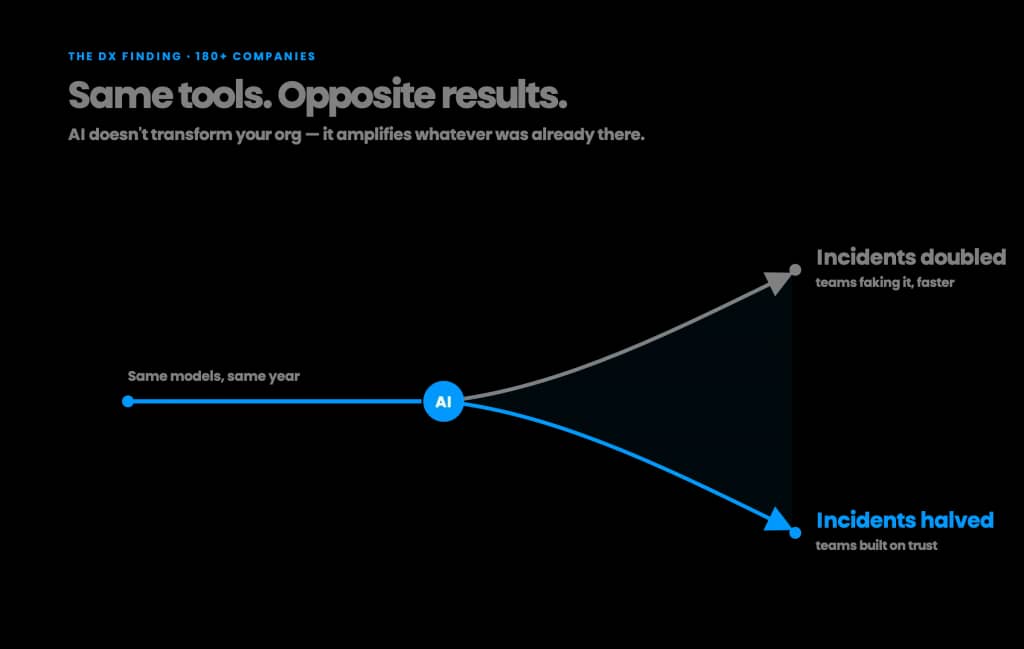
Dysfunctional organizations are now dysfunctional faster.
AI turns out to work less like a transformation and more like a magnifying glass: it makes whatever was already true about your company louder. Teams with trust made fewer mistakes. Teams that were faking it now fake it faster. The model doesn’t save you, your culture does.
And it’s not just incidents. An MIT study of enterprise AI projects found that about 95% produced no measurable financial impact at all. A small slice generates the returns. The rest is theatre.
Earlier this year Kent Beck, Steve Yegge, and Laura Tacho, three of the most credible engineers of the last few decades, met at a retreat Martin Fowler organized to mark 25 years since the Agile Manifesto. They put their names to a single sentence: organizations are constrained by human and systems-level problems, and no technology improves organizational performance without addressing those constraints first. In other words, it was never a technology problem.
Organizations are constrained by human and systems-level problems, and no technology improves organizational performance without addressing those constraints first. In other words, it was never a technology problem.
One more observation, and I find this one damning. Tacho likes to say that the Venn diagram of developer experience and agent experience is a circle: fast CI, good docs, and clean feedback loops help the robots exactly as much as they help the people. Engineers begged for those things for decades and got told no. Now the same companies write huge checks for the exact same things, as long as you call it “agent experience” instead of “developer experience.”
We wouldn’t spend it on humans. We’re happy to spend it on the robots. If you want to know what’s wrong with our industry, start there.
If a good developer with a model can rebuild your product in a weekend, what’s your moat?
Every founder I talk to is asking this, usually not out loud. The answer, more and more, comes down to four things. Distribution, the channel you own. Data nobody else has, the kind that lives behind your customers’ walls. Being the connective tissue everything else has to plug into. And, oddly, regulation, which you don’t build, you inherit, by surviving in a hard domain long enough to actually understand it.
A model upgrade doesn’t get you a banking license, or compliance, or a ten-year relationship with a customer who is slow to trust. Whoever owns the trust and the rails beats whoever owns the cleverest tool.
The companies that win the next stretch won’t be the biggest aggregators of everything. They’ll be the specific team a customer can’t outgrow. Valuable because of how they treat people, not despite it. A lot of slower, more careful, more regulated players have spent years apologizing for exactly the traits that are about to become their moats.
So what do you do tomorrow morning? Dead reckoning.
You can’t fix the macro. You can navigate the micro, and the oldest way to do that is the humblest.
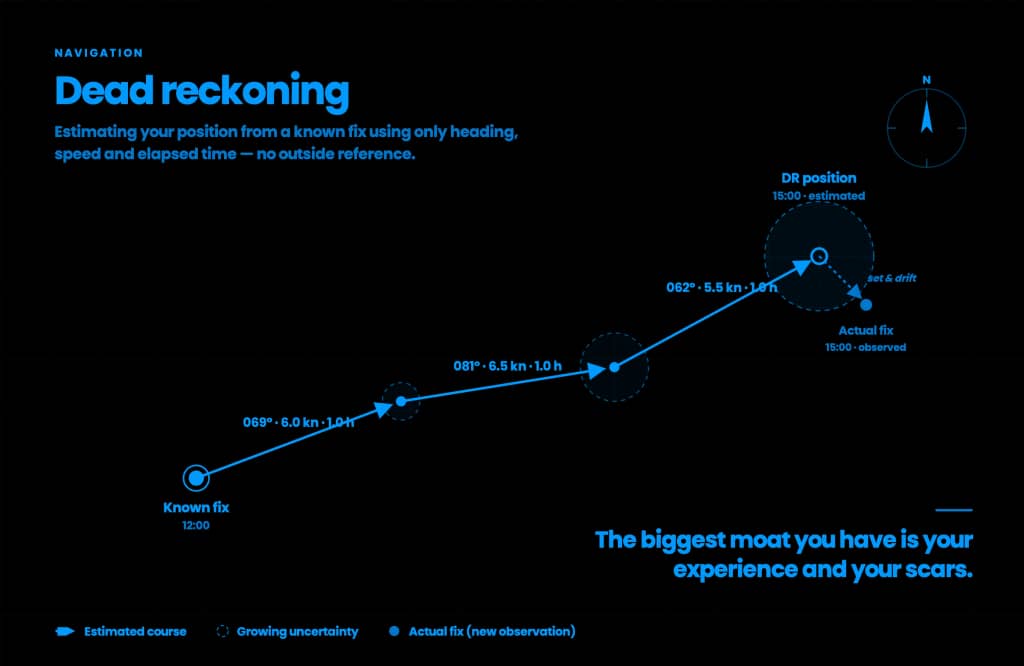
When Shackleton’s ship was crushed in the ice, his captain, Frank Worsley, took a tiny boat across roughly 1,300 kilometers of the worst ocean on the planet, over two weeks, with almost no clear sky to take a reading. He navigated mostly by dead reckoning: I know where I started, I know my speed, I know my heading. Every man survived.
That’s the only kind of navigation any of us have for the next few years. You don’t need to know exactly where you are. You need to know where you started, how fast you’re going, and which way you’re pointed. There is no GPS for the future of work.
So, four things this week, one per direction. Read one document with no AI summary first. Sign one decision out loud and write a one-paragraph postmortem on it. Do one piece of work you’d do even if nobody paid you. Write down one thing AI got wrong.
The biggest moat you have is your experience and your scars.
And in the meeting tomorrow, when someone says “we should put AI on this,” ask three questions before anyone else speaks.
What does this make possible? That’s the excited question.
What could this break? That’s the scared question. Honor it, fear is just risk-sensing in a bad mood.
Who do we want to be while we figure this out? That’s the lost question, the one nobody asks because there’s no spreadsheet for it. Ask it anyway.
One last thing. Search for True North.
A compass points to magnetic north. What you actually need is True North. The gap between them has a name, declination, and it’s invisible, it varies depending on where you’re standing, and it drifts over time. Follow the needle blindly and your error grows with every kilometer.
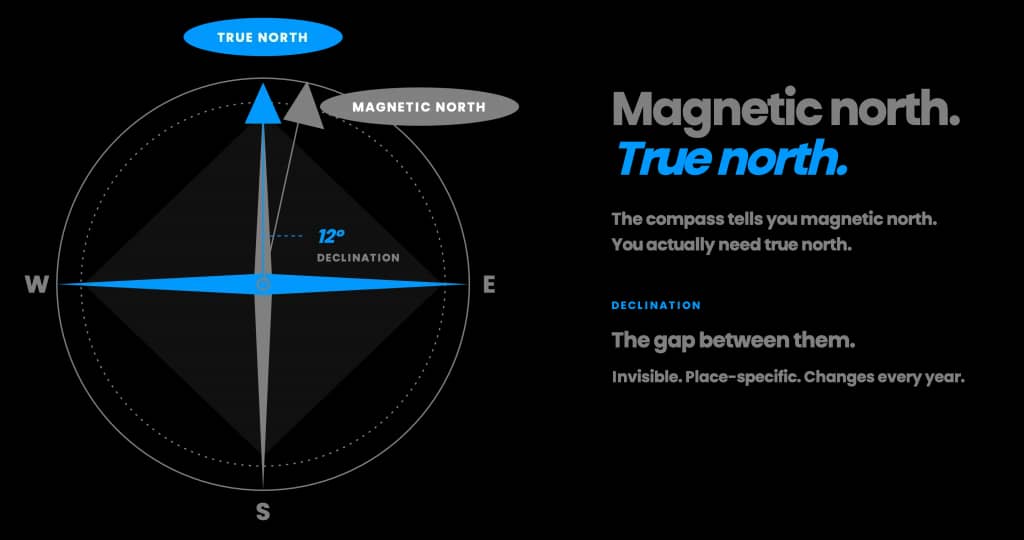
AI is the instrument. It points to the most probable next step. True North is the step you should actually take, and closing that gap is not the model’s job. It’s yours. That’s what “stay human” really means: a daily correction, not a poster.
That’s what “stay human” really means: a daily correction, not a poster.
Which tells me what to do with that note from 2am. Jobs are changing, we’re moving faster than ever, we don’t know where we’re going: that half is simply true, and no roadmap fixes it. But the part about slowly becoming less human, the part I’ve been arguing with myself about all year? I’ve stopped believing it’s something that happens to us. It happens when we stop correcting. Which means it’s optional.
One image to leave you with. In 1976, a wooden canoe called Hōkūleʻa crossed thousands of kilometers of open Pacific with no instruments. The navigator, Mau Piailug, was one of the last people alive carrying a wayfinding tradition three thousand years older than the magnetic compass. He read the stars, the swells, the flight paths of birds, the way clouds gather over islands you can’t see yet.

His apprentice, Nainoa Thompson, asked how he never got lost. He said: “If you can read the ocean, you will never be lost.” Years later, Thompson put it more simply. “We are the compass.”
People who had never seen a compass crossed the biggest ocean on earth, because the best navigation tool they had was a mental one.
The instruments are getting extraordinary. They’re also getting cheap, fast, replaceable, and increasingly willing to tell us confident things that aren’t quite true.
We are the compass. We always were.
Stay grounded. Stay skeptical. Stay human. Stay practiced.